

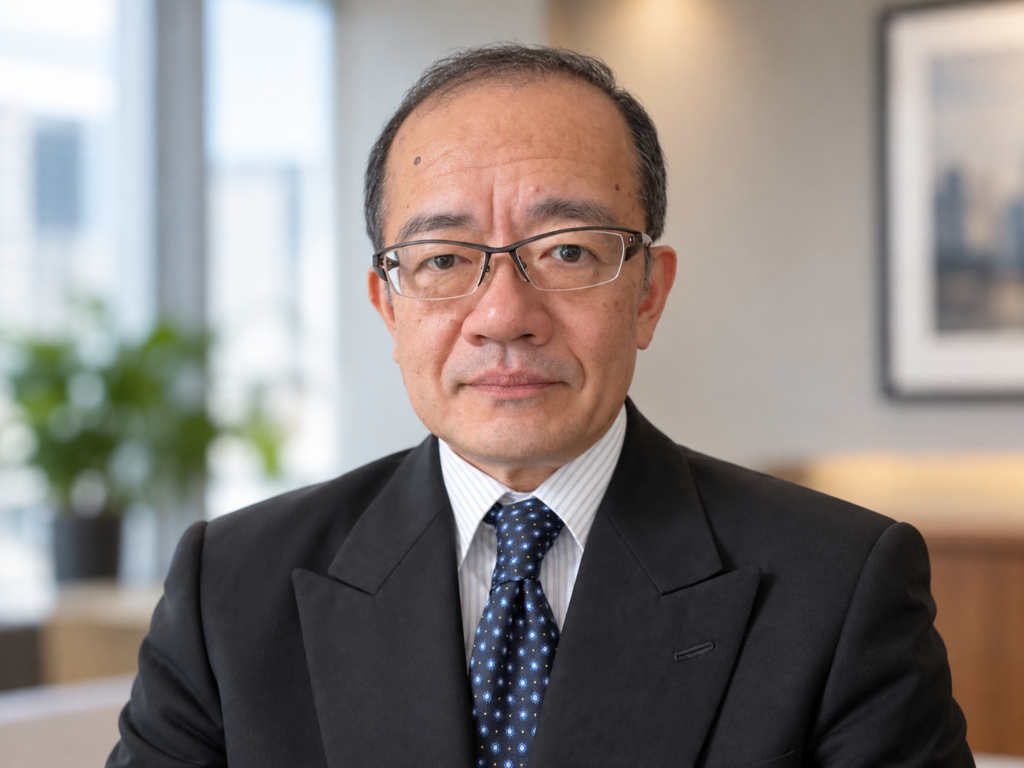
In this edition of Voces de la Cámara, we speak with Masato Hoshino, Assistant General Manager, Global Business at Nissin Corporation, to learn more about his international career in logistics, his experience across Europe, and his perspective on cross-cultural collaboration, corporate culture, and building strong global relationships.
1. How did your professional journey lead you to your current role at Nissin?
I joined Nissin Corporation in 1990 and have spent my 37-year career consistently involved in international logistics, including air, sea, and rail transport.
My professional path has been largely defined by 18 years of overseas assignments in Europe: nine years in Germany (Hamburg and Frankfurt), six years in Austria (Vienna), and three years in Russia (Moscow). These extensive international experiences provided a solid foundation for carrying out my current responsibilities.
2. What motivated you to work in an international environment?
Since childhood, I have been fascinated by European culture, languages, and modern history. I was particularly intrigued by Germany; like Japan, it was a nation rebuilding after WWII, and at that time, it sat at the center of the Cold War divide. Driven by these interests, I majored in German Studies, Economics, and Politics at university, during which I spent a year as an exchange student in Germany.
While dedicated to my studies, I also traveled extensively throughout both East and West Germany, witnessing the geopolitical realities of the era firsthand. Upon graduation, I sought a career where I could apply this knowledge. When I was introduced to Nissin Corporation, I saw a perfect opportunity to bridge markets
by facilitating the cross-border transport of high-quality Japanese and German products.
3. How did you come to work in a Japanese company that operates in Spain?
While my primary focus during my tenure in Germany was air freight, I had the opportunity to support the growth of our Barcelona office’s air cargo division. I was also deeply involved in the logistics of transshipping air freight from Japan to Spain via Germany, creating a vital link within our European network.
On a personal level, Spain has always felt very close to me because my wife majored in Spanish at university. This blend of professional collaboration and personal connection made Spain a very familiar and special part of my career.
4. What differences or similarities do you see between Japanese and Spanish corporate cultures?
Rather than a specific difference between Japan and Spain, I’ve noticed a fundamental cultural gap between Japan and Europe as a whole. A clear example is the concept of «Sick Leave.» As it happened, the first time I fell ill and ran a fever after moving to Europe was during my assignment in Austria.
Following Japanese custom, I called the office to request a day of «Paid Vacation.» To my surprise, the HR manager was genuinely shocked. She told me: «Why wouldn’t you use sick leave? Vacation is for recreation and refreshing your mind. I simply cannot understand the Japanese mindset of using vacation days for illness.»
This was a major revelation for me. Whether in Austria, Germany, Russia, or Spain, this clear distinction between recovery and recreation is a standard and healthy part of the culture – one that I believe Japanese corporate society could greatly benefit from.
5. What skills or qualities do you believe are essential when working across cultures?
I believe the most essential quality is the ability to maintain a fine balance between flexibility and stability. On one hand, you need stability to pursue internal goals and objectives with unwavering consistency. On the other hand, when working with people from diverse cultural and linguistic backgrounds, their approaches to the same task will naturally differ.
It is crucial to have the flexibility to understand and accept these different methodologies. The key skill lies in harmonizing these two seemingly conflicting qualities – remaining firm on the «what» (the goal) while being adaptable on the «how» (the process).
6. Looking back at your career so far, is there a moment or decision that significantly shaped your path?
The most defining moment of my career was the decision to accept an assignment in Russia – a true leap into the unknown.
Having spent my life and career in «Western» societies like Japan and Germany, the idea of moving to Russia – a country about which both Japanese and Germans often had a less-than-positive image – was initially overwhelming and caused much hesitation. This was especially true since I had only visited once on a short business trip and did not speak the language.
However, after discussing it with my family, we concluded that since we only live once, this experience would undoubtedly enrich our lives. We decided to move to Moscow together. Professionally, it was a period of great achievement where I worked on projects linking Asia and Europe via the Trans-Siberian Railway. More importantly, we were blessed with wonderful colleagues and friends, experiencing firsthand the genuine kindness of the Russian people.
Those three years remain an invaluable treasure for my entire family. My only regret is that, due to my busy schedule, I couldn’t dedicate as much time to studying the language as I would have liked – my Russian conversation skills remained a challenge until the very end!
7. Have you experienced any cultural differences that influenced the way you work?
The working styles I observed in Austria and Germany left a lasting impression on me. Seeing my colleagues start work around 7:00 AM and head home by 4:00 PM was eye-opening.
During the long summer days in Europe, people rarely worked overtime; instead, they prioritized relaxing with their families on their terraces over a glass of wine or beer. Before my overseas assignments, I used to save my stress relief solely for the weekends, so I deeply envied their ability to recharge daily and tried to adopt this lifestyle as much as possible while living there.
Later, during business trips to Spain, I encountered a different yet equally fascinating rhythm – colleagues who were slow starters in the morning but embraced life with vibrant energy late into the night. These experiences taught me the importance of integrating «life» into «work,» rather than just waiting for the weekend to find happiness.
8. What does a typical day look like in your role at Nissin?
My typical day at our Tokyo headquarters is centered on managing and supporting our European subsidiaries. A significant part of my role involves evaluating investment proposals from these offices; I assess their long-term value and, when convinced of their potential, submit them to our executive management for approval. I also analyze monthly financial performance and prepare reports for our leadership.
When a subsidiary faces challenges, I work closely with local teams to develop improvement strategies and discuss the ideal form of sales support to be provided by the head office.
Ultimately, my day is dedicated to ensuring that our European network remains robust and strategically aligned with our global vision.
9. What do you enjoy most about working in an international environment?
Growing up, I recall how Japan’s «island nation mentality» or insular nature was often pointed out by people from other countries.
Historically, surrounded by the sea and shaped by periods of isolation, Japanese society has indeed had a tendency to be closed off.
Perhaps as a counter-reaction to this, I have always found immense joy in reaching out to people with different cultures, temperaments, and languages.
To me, the true charm and motivation of working in an international environment for over 30 years is the opportunity to build relationships of mutual trust through constant dialogue and vibrant exchange—never shying away from healthy debate.
This process of connecting with others on a human level remains the core of my professional passion.